Office Furniture Rework Cost vs Buying New: Where the Money Goes
In this guide
Reworking office furniture usually costs significantly less than buying like-for-like new, because you pay for the change — a new top, a resize, a re-finish, a shroud — rather than for the whole piece plus the disposal of the old one. The saving is biggest where the structure is sound and only the surfaces are dated; it shrinks or disappears where frames are failing or the piece is obsolete.
REFRAME quotes reworks from a survey rather than a price list, so this guide carries no prices. What it does is show where the money goes in each route, which is what lets you predict the answer for your own furniture before anyone visits.
Where the cost of new office furniture goes
A new desk, table or storage run is priced on everything it takes to exist: raw material, manufacture, finishing, packaging, freight to site and installation. On top of that sits a line that rarely appears on the supplier's quote but always appears on yours: clearing the old furniture. Collection, disposal or recycling of a floor of desks is real money and real time, and it happens before the new furniture can land.
Then there is lead time. Made-to-order ranges can carry manufacturing and shipping windows measured in weeks or months, and a delayed delivery has its own cost when a floor is standing empty.
Where the cost of a rework goes
A rework is priced on what changes. For a typical desk re-top or resize that means:
- Survey and drawings. Measuring the frames and units, and drawing the new tops, panels or components so they fit first time.
- New components. Tops in MFC, veneer, Fenix or laminate; shroud panels; brackets, cable trays and link kits; hardware.
- Finishing. Edging on tops, powder-coating steel in a new RAL colour, repainting.
- Fitting. Removing old tops, fitting new ones, reconfiguring banks, installing shrouds — often phased around an occupied office.
What you do not pay for is the frame or carcass, its freight, or its disposal. That is the whole saving: the most expensive, heaviest and most durable part of the furniture is already in the building.
Rework vs new at a glance
Scroll across to compare all columns →
| Rework what you own | Buy new | |
|---|---|---|
| Cost | Usually significantly less than like-for-like new | Full price, plus clearing the old furniture |
| Lead time | Typically 2–4 weeks from drawing sign-off | Varies; long for made-to-order ranges |
| Disruption | Tops cut and edged off-site; fitting phased around the office | Strip-out, delivery and installation of whole pieces |
| Waste and embodied carbon | Structure stays in service; offcuts and worn parts only | A full new footprint, and old pieces to clearance |
| Consistency | Uniform finish across the reworked run | Uniform |
| Fit to the new plan | Sized to the floorplan, columns included | As the catalogue sizes allow |
| Warranty | On the work and the new components | Full manufacturer warranty |
| When it wins | Sound frames, dated look, changed layout | Failed structure, obsolete mechanisms, a wholly different use |
The comparison assumes sound structure. Where it is not sound, the table's first row flips, and an honest survey says so before any money is spent.
What drives the cost of a rework
Six things move a rework quote, in roughly this order:
- Condition of the structure. A straight steel frame with working feet is a straight re-top. A frame with a failed weld is a repair first, and may not be worth it.
- Quantity and repetition. Forty identical re-tops are drawn once and cut as a batch; one odd-sized table is drawn on its own. Per-unit cost falls with repetition, which is why a floor of matching desks reworks so well.
- Materials and finish. MFC is the cost-effective choice; veneer, Fenix and solid timber cost more per top. Powder-coating frames adds a step but unifies mismatched legacy stock.
- How much design is involved. A like-for-like re-top is a drawing and a cut list. A reconfiguration — splitting benches, adding positions, building a breakout table from desk frames — is a small bespoke project.
- Access and fitting. Out-of-hours work, occupied floors and awkward lifts add fitting time. Tops that can be cut off-site while you keep working keep this down.
- Extras that modernise the desk. Cable trays, grommets and power modules are cheap relative to a new desk, but they are new components and appear on the quote.
Examples from real projects
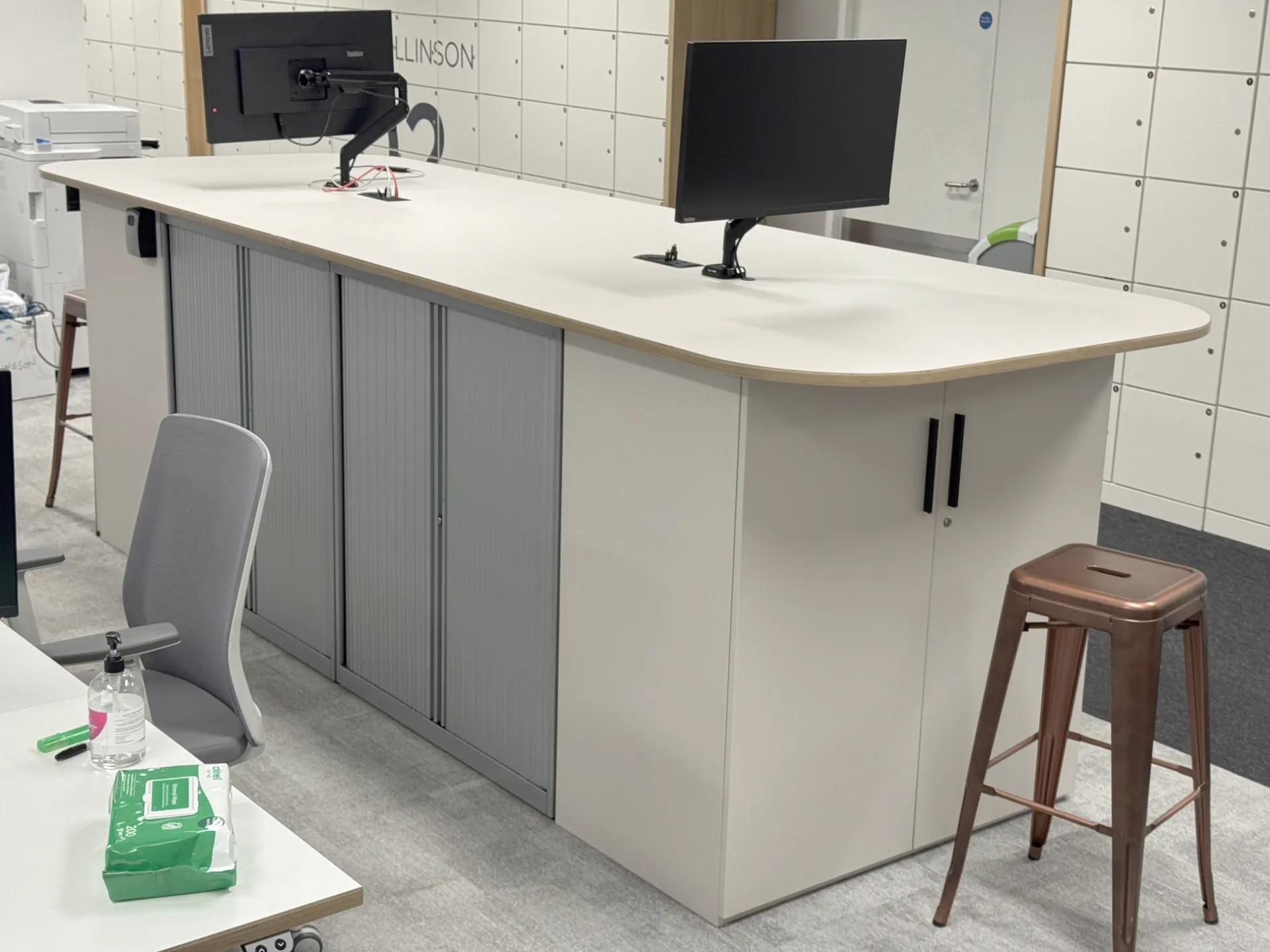
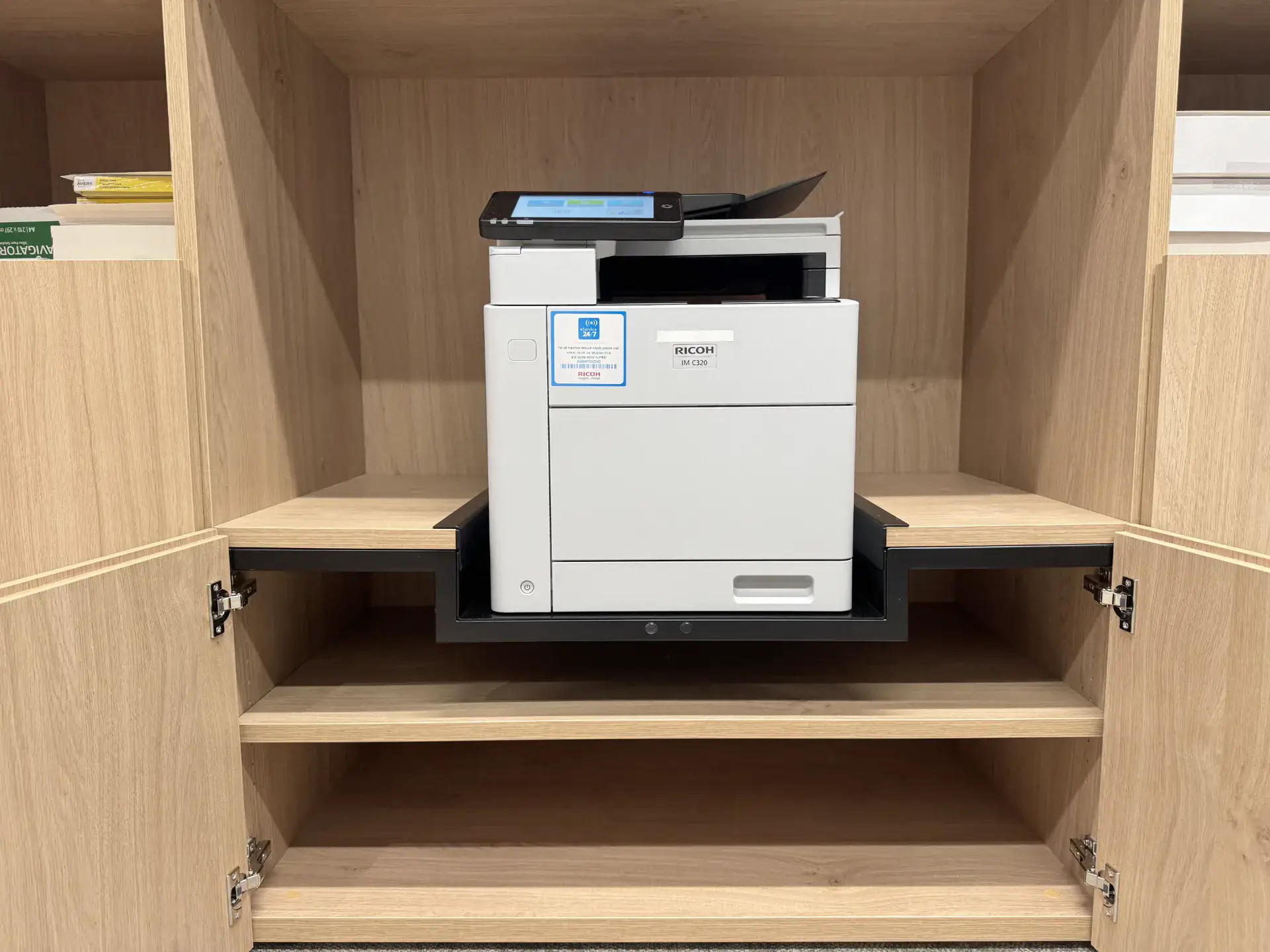
REFRAME's projects page shows the pattern. A breakout table was built on desk frames the client already owned, with a new Forbo top and an integrated planter, at lower cost than buying new. A bank of structurally sound lockers that looked tired was refaced with bespoke shroud kits instead of being replaced. An IT tech bench was made from existing tambour units with new cupboards pre-drilled for equipment and power. An existing cabinet was adapted with a new fitment to house a printer. In each case the client paid for the change, not the piece.
When buying new is the better value
Reworking is not a reflex. New is the honest answer when:
- frames have failed welds, corrosion or bent legs, or carcasses have taken water damage;
- the mechanism is obsolete and a suitable repair or replacement part is unavailable; seating needs its own assessment of condition, safety and repair cost;
- the piece is so non-standard that adapting it costs as much as replacing it;
- the use has changed completely, for example from fixed desks to agile settings;
- you need volume and have little existing stock to build on, in which case a ready-made range such as Recon or R!se is the pragmatic route.
Most real projects are a blend: rework what is sound, replace what is not, and fill the gaps with a ready-made range. The remanufactured office furniture guide explains what a proper rework includes, so you can compare quotes like for like.
How to get a real number
Send photos of a typical desk or unit (including the underside and any damage), quantities, current sizes, the new floorplan if you have one, and a finish reference. REFRAME comes back with an itemised quote — design, manufacture, delivery — and states the lead time. There is no minimum order, and if a rework is not the right answer for a piece, the survey says so rather than selling you one.
Frequently asked questions
Usually, yes. REFRAME reworks sound desks, tables, storage and lockers for significantly less than like-for-like new, because you pay for new tops, panels, finishes and labour rather than whole pieces and their disposal. The saving depends on condition, quantity and finish, so it is quoted from a survey, not a price list.
It depends on quantity, top material and edge, and whether the frames need powder-coating or new cable management. REFRAME prices re-tops from a survey and a cut list, with per-unit cost falling as the batch grows; a floor of matching desks reworks particularly well. Expect the total to be significantly under the cost of equivalent new desks.
Yes. REFRAME's reworks carry a commercial warranty on the work and the new components, and because every drawing is archived, a piece can be repaired, resized or extended years later.
Typical reworks run two to four weeks from drawing sign-off with REFRAME, and tops can often be cut and edged off-site while the office keeps working. New made-to-order furniture can carry manufacturing and shipping windows of weeks or months, plus the time to clear the old pieces.
Anything with failed structure: bent or corroded frames, failed welds, water-damaged board, or obsolete mechanisms. Seating needs a separate assessment of mechanisms, upholstery, safety and repair costs. REFRAME says so at the survey stage rather than quoting a rework that will not last, and the leftovers are separated for recycling rather than skipped.