Planter Tables and Biophilic Office Design: A Practical Guide
In this guide
A planter table is a meeting or breakout table with a planter built into the top: a lined, watertight steel trough deep enough for real plants, with the power and cable management routed around it. It puts greenery in the middle of a floorplate without taking floor space, and it can be a ready-made product such as REFRAME's Orbital, a bespoke piece, or a rework of desk frames you already own.
REFRAME designs planter tables and freestanding planters in London and has them built by vetted UK partners. This guide covers the practical questions — how the planter is built, watering, power, sizes and seats — and how to choose between the Orbital, a bespoke table and a rework.
What "biophilic" means for office furniture, without the jargon
Biophilic design is the practice of bringing natural elements — plants, natural materials, daylight — into a building. For furniture, the useful part is simple: put planting where people gather, on a surface that is already there, and use natural materials such as solid oak where they earn their place. A planter table is not a wellbeing programme; it is a table with plants in it, designed so the plants survive and the table still works.
How a planter is built into a table
The planter has to hold wet soil, keep water away from the top and the cabling, and sit on a frame that carries the weight. On the Orbital, REFRAME's ready-made planter table, that means:
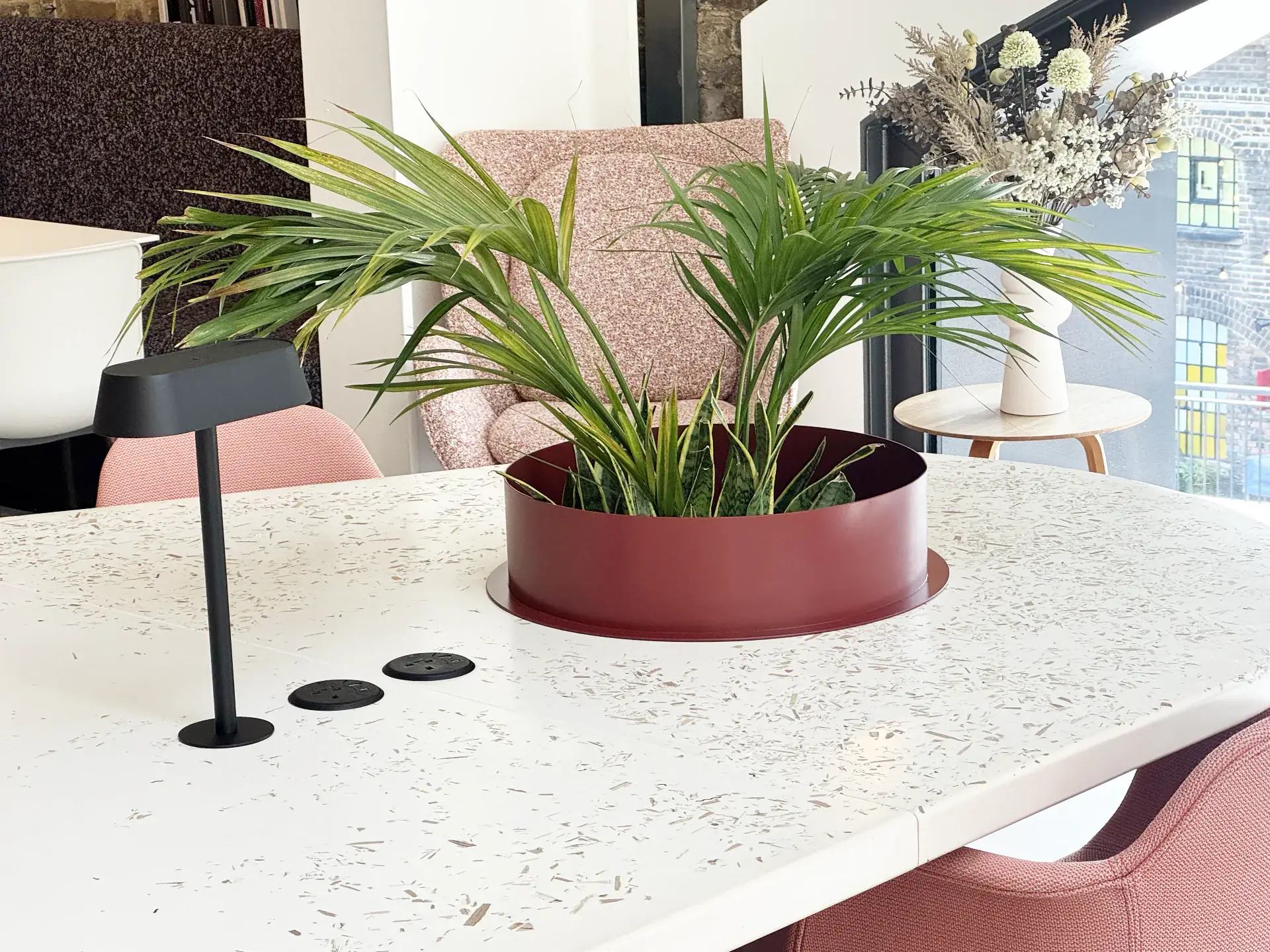
- a steel planter with a film liner, 450 mm internal opening and 600 mm deep — deep enough for a real plant rather than a token pot;
- a steel frame under the top, so the planter's weight is carried to the legs, not the board;
- solid oak legs, natural or black, and a top in MFC (a cashmere top with a RAL 6013 green planter, or anthracite with oak, are two of the finished combinations);
- the planter powder-coated in any RAL colour.
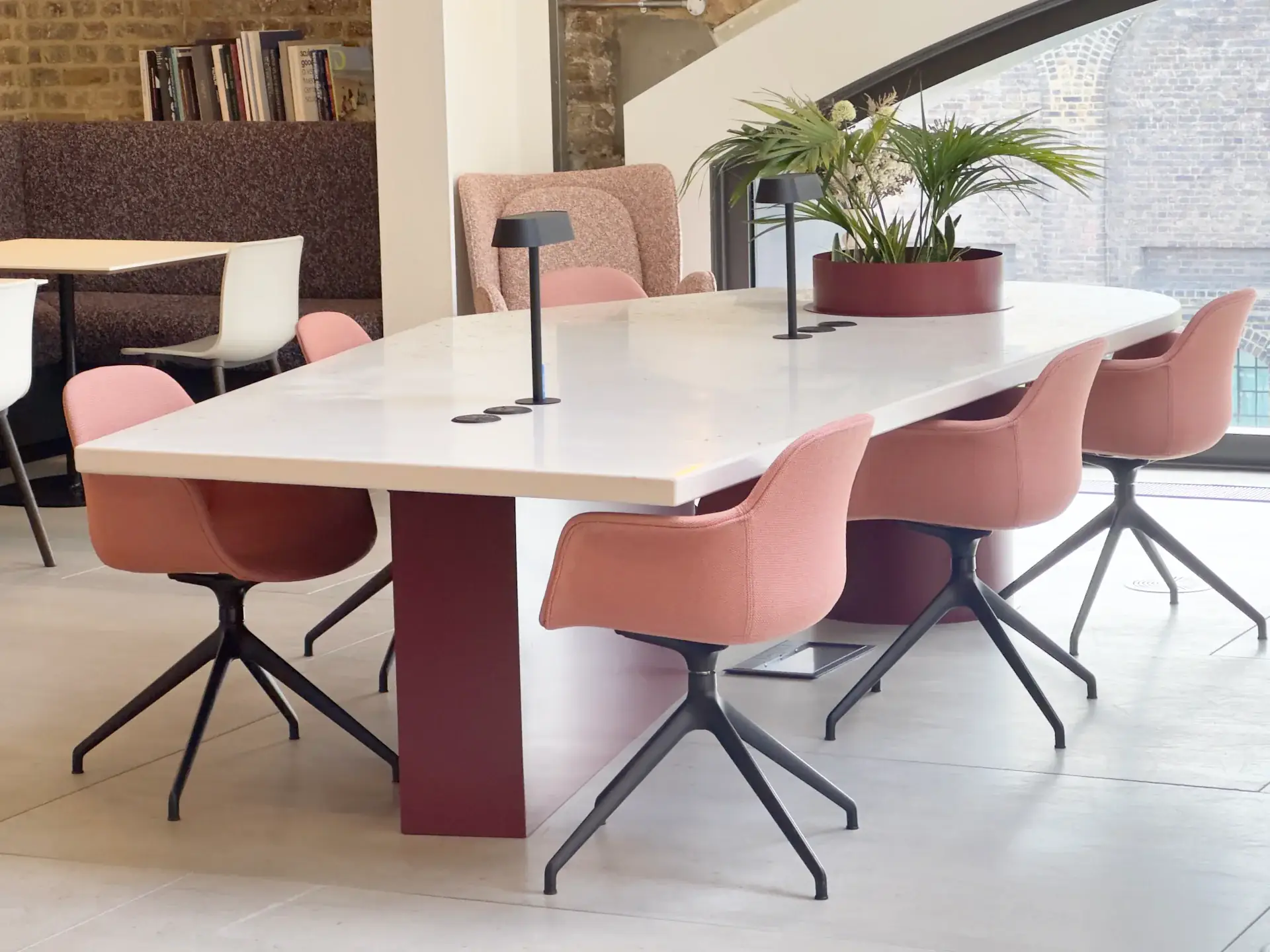
A bespoke planter table follows the same logic with the numbers changed: a longer trough down the centre of a rectangular breakout table, a planter sized to the plants you already have, or a large freestanding interior planter in a bespoke colour, which REFRAME has made for a recent project.
Watering, drainage and the plants themselves
A planter set into a table cannot drain into the table, so the liner is watertight and the planting is managed rather than flooded. The practical approach is to keep plants in their own pots inside the liner, so they can be lifted out to drain or be swapped, and to water sparingly. Choose plants for the light the room actually gets; your plant supplier or maintenance contractor will advise on species and a watering routine. Tell the maker whether a contractor will maintain the plants, because that affects how deep and how accessible the planter should be.
Power and cable management around a planter
Planters and power share a top, so the routing is designed, not improvised. The Orbital offers optional power integration with cable management run under the top and down a leg; a REFRAME breakout table on a reclaimed flooring top has power units set into the surface beside the planter. The rules are the same on any planter table:
- power modules sit away from the planter, where people actually put laptops;
- cables run under the top and down a leg or column to a floor box, never through the planter zone;
- the planter liner and the cable route are drawn together so neither compromises the other.
Sizes, heights and seats
The Orbital comes in diameters from 2,000 mm to 3,000 mm at 740 mm high and seats up to ten people at 3 m. Rectangular bespoke planter tables follow breakout-table rules: allow roughly 600 mm of edge per person seated, standard seated height around 720–740 mm, or poseur height around 1,000–1,100 mm for short stand-up use. A central planter takes space from the middle of the top, so a planter table needs to be a little wider than the same table without one; the breakout tables guide covers sizing in more detail.
Orbital, bespoke, or rework existing frames?
Scroll across to compare all columns →
| Orbital (ready-made) | Bespoke planter table | Rework existing frames | |
|---|---|---|---|
| Shape and size | Round, 2–3 m diameter, 740 mm high | Any shape or size drawn for the room | Governed by the frames you own |
| Planter | 450 mm opening, 600 mm deep, any RAL | Sized and positioned to the brief | Planter designed into a new top |
| Finishes | MFC top, oak legs natural or black, planter any RAL | MFC, veneer, Fenix, laminate, reclaimed flooring; steel any RAL | New top and planter to the new scheme |
| Power | Optional integration | Designed in where people sit | Added with the new top |
| Lead time | Confirmed in the quote | Small pieces 2–4 weeks from sign-off; larger tables longer | Often 2–4 weeks |
| Cost | Product price, customisable | Quoted per brief | Usually significantly less than new |
| Warranty | 5 years | On the work and components | On the work and new components |
The rework column is not theoretical: a recent REFRAME project built a breakout table on a client's existing desk frames with a new Forbo top and an integrated planter, at lower cost than buying new. If you have redundant desk frames and want a planter table, that is the first route to price.
Finishes that work around plants
Water and soil find their way onto a top, so the surface matters. MFC, laminate and Fenix wipe clean and cope with the odd spill; solid timber and veneer want a tough sealed finish. Reclaimed flooring has been used as a top on a REFRAME planter table where the client wanted a warmer, more characterful surface. Planters are powder-coated steel in any RAL colour, so the planter can match a brand colour or contrast with the top. Physical samples are available with an enquiry, and every drawing is archived, so a table can be extended or re-topped later.
Frequently asked questions
A planter table is a meeting or breakout table with a lined, watertight planter built into the top, so real plants sit in the middle of the table. REFRAME makes the Orbital, a round planter table for up to ten people, designs bespoke planter tables, and has built one on a client's existing desk frames.
Deep enough for real plants rather than a token pot. REFRAME's Orbital planter is 600 mm deep with a 450 mm internal opening, steel with a film liner. A bespoke planter is sized to the plants you intend to use and to whether a maintenance contractor will lift them out to water and drain.
Yes. The Orbital offers optional power integration, and REFRAME designs power modules into bespoke planter tables away from the planter, with cables run under the top and down a leg to a floor box. The planter liner and the cable route are drawn together so neither gets in the way of the other.
Often, yes. REFRAME has built a breakout table on a client's existing desk frames with a new Forbo top and an integrated planter, at lower cost than buying new. Sound frames take a new top with the planter and cable management designed in; the survey confirms what the frames can carry.
Up to ten at the 3 m diameter; the Orbital is available from 2,000 mm to 3,000 mm across at 740 mm high, on solid oak legs with a steel frame, a 600 mm-deep planter in any RAL colour and a 5-year warranty. Finishes are customisable.